What is Poisson’s ratio?
When is Poisson’s ratio important?
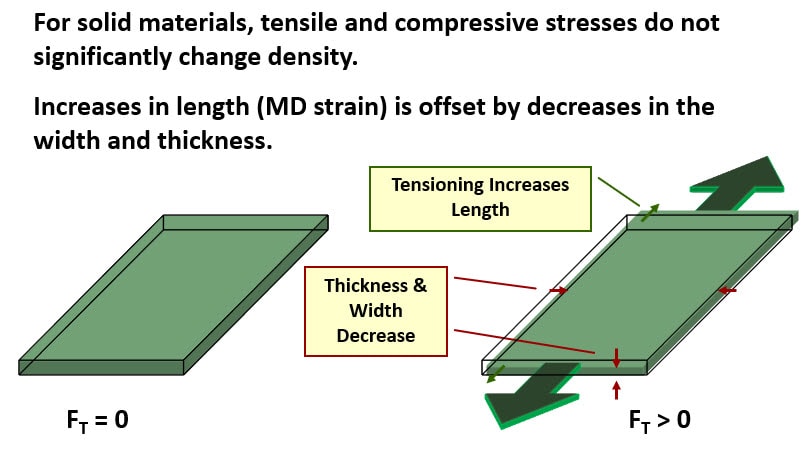
When you tension a web, you change its length, but you may not make a significant change in its density or volume (volume = length x width x thickness). If the length increases, but the volume doesn’t change significantly, then the web must shrink in another direction (and it does). Most tensioned webs will deform and see a decrease in width and thickness.
When a sample of material is stretched in one direction, it tends to get thinner in the other two directions. Poisson’s ratio (ν), named after Siméon-Denis Poisson, is a measure of this tendency. Poisson’s ratio is the ratio of the strain normal or perpendicular to the applied load divided by the strain in the direction of the applied load. In web tensioning, we often ignore the small thickness change from tensioning, but the width change can be significant. In many webs, the Poisson’s ratio is around 0.3.
Poisson’s ratio will be much higher in other webs, such as textile, porous films, tissues, and foams, where air is pushed out under tension. In high Poisson’s ratio web, managing width loss from tensioning can be a top concern. Poisson’s ratio will also contribute to curl problems in laminates and width changes or MD buckling in wound rolls.
Example: Web tension may stretch thin polyethylene or polypropylene films to 1 percent in their machine direction. This tension will also create a width change or necking of 0.3 percent. If the web is 1.5m (60-inches) wide, this would reduce the width by 4.5mm (0.18 inches or 180 mils).