
Why is diameter feedback used with torque control?
If you want constant tension as a roll diameter increases or decreases, you have to adjust torque. Tension from torque = torque / radius. If the radius is changing, torque needs to change proportionally to keep the torque contribution to tension constant.
By combining torque control with roll diameter, an open-loop torque control system can do a reasonable job-creating constant tension at a constant speed. Certainly, this approach is an upgrade from having an operator manually change torque with a diameter (or forgetting to). Any of the following methods are used for open-loop, diameter-compensating torque control.
How is diameter measured?
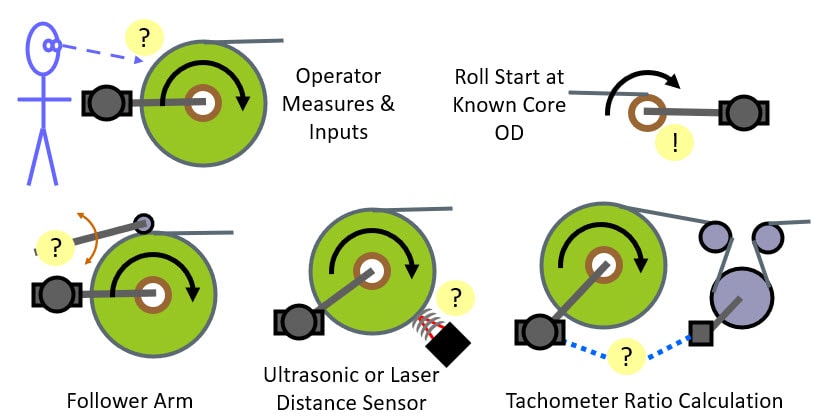
There are three common and two less common ways to measure or calculate diameter at unwinding or winding.
- Follower arm or nip roller – A pivot arm or sliding carriage is loaded against the unwinding or winding roll. An encoder or LVDT detects the arm or carriage motions as it moves with changes in roll diameter.
– - Ultrasonic distance measurement – An ultrasonic distance sensor is mounted pointing at the core or roll’s outer diameter, detecting the distance to the roll and converting the signal to roll diameter.
– - Tachometer ratio calculation – An encoder or tachometer monitors the revolutions per minute (rpms) of the winding or unwinding roll. A second encoder or tachometer monitors the rpms of a roller of known diameter in no-slip contact with the moving web (often the nearest driven roller). The roll diameter is calculated as D(roll) = D(roller) x n(roller) / n(roll) where n is rotational speeds in rpms. The disadvantage of this method is that it requires a moving web and cannot provide any roll diameter information needed to set the starting rpm of a unwinding motor.
– -
Web thickness and revolution calculation – For a given web thickness, diameter is continuously calculated as the core’s outer diameter of the core plus one web thickness for each roll revolution. This type of calculation will be off by some amount due to thickness variation, web compression, and entrained air.
– -
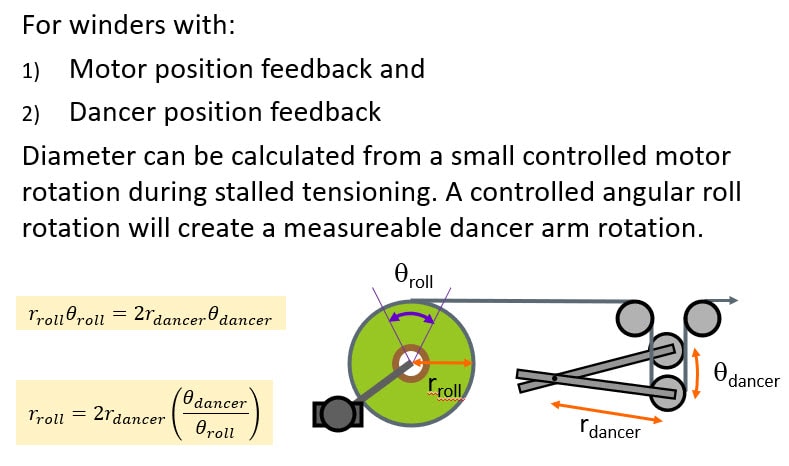
Dancer roller jog calculation – For driven unwinds and winders with dancer roller feedback, the motor-dancer system can be used to sense initial diameter. In the stall mode (line under tension, but at zero line speed), jog the motor 45 or 90 degrees and monitor the dancer motion. The dancer (with 180 degree wrap) will move 1/2 the arc length dispensed or accumulated by the small roll rotation and allow a calculation of roll diameter.

All of these methods are useful for any winding or unwinding system, even if motor driven. Initial roll diameter is used to: 1) set a motor’s initial rpm and 2) calculate inertial torque needs of acceleration.