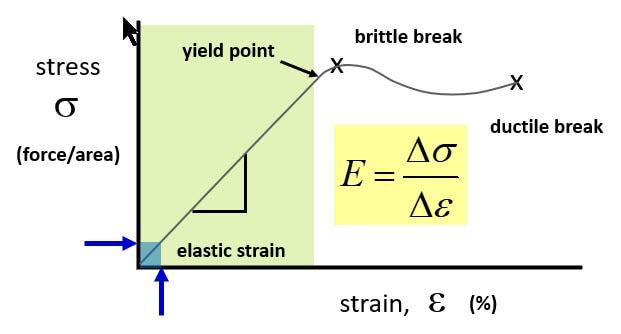
What tension is the right tension for a web?
What tension will break or deform a web?
The answer to the second question is part of the answer to the first question.
Most experts will advise to run your web at 10% of the tension that would damage the web, a safety factor of 10:1.
As a starting point or rule of thumb, average web tension should be 10 percent of the web’s break or yield point. This 10:1 safety factor may seem high, but this tension setpoint is the average tension in the web. Web tension is often talked about as one value, but it should be viewed as a contour, varying vs web width and web path length. Crossweb tension can easily vary by 2:1 or more across the web’s width due to web bagginess or roller misalignment. Tension variations over time of 10% are fairly normal and can vary as much as 50 or 100 percent during acceleration or within tension zones.
The most common web tension is 200N/m (1 PLI). Ninety percent of webs are run between 60-600N/m (0.3-3.0 PLI) and 95 percent of webs are run between 20-2000 N/m (0.1-10 PLI).
When a web will break or deform is a material property. In all materials, breaking and deforming will occur in response to not just force, but stress (which is the force over a cross-sectional area). In tensioning a web, the cross-sectional area is the width times the thickness. Material, thickness, and width will all contribute to a web’s strength and resistance to breaking or deforming (a.k.a. yielding).
A 25mm (1-inch) wide web will break easier than a 250mm (10-inch) wide web. A 50 micron (2-mil) thick web will be harder to break or yield than a 12 micron (0.5-mil) thick web. A steel web will be harder to break than a polyethylene web. (Harder to break = higher critical tensile break stress.)
A tensile-elongation test is the best way to find your web’s break or yield point. A tensile-elongation tester pulls on a strip of the web precisely measuring the elongation distance and force. When the web breaks is clear. When it yields may not be as clear. Yield is the point where the web will no longer elastically recover. When tension is removed, it will not return to its original dimension.
.