What is the right tension for a laminated or coated product?
The recommended target tension is a starting point, but many factors may mean higher or lower tension is better.
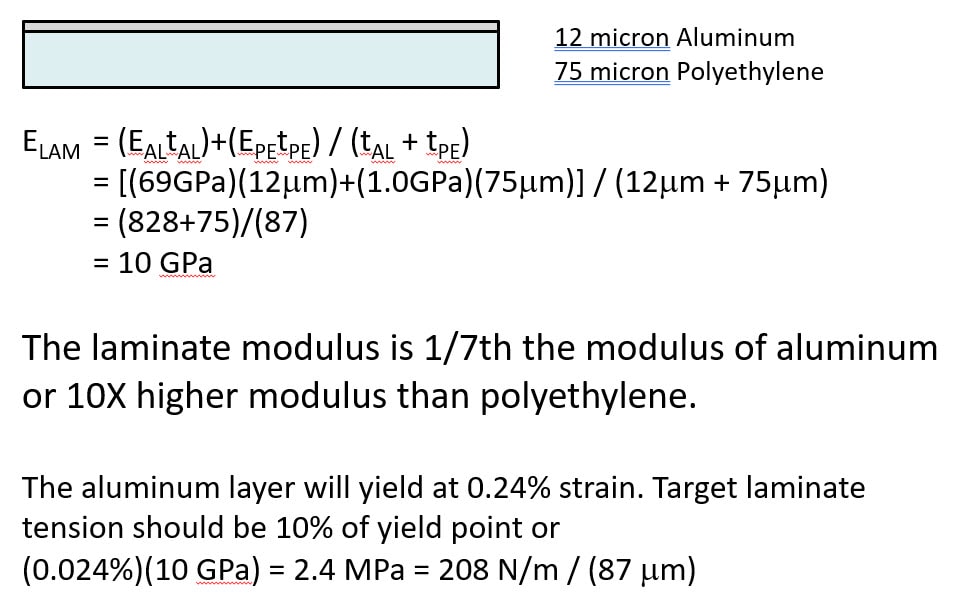
The modulus of a laminate will be the thickness weighted average of the combined layers (see the example of an aluminum-polyethylene laminate).
The effective modulus of a coated or laminated web is found by summing each layer times its modulus and dividing by the sum of the thicknesses. For soft layers, such as most adhesive, count their thickness, but consider their modulus to be zero. Ultra-thin layers, such as metal vapor coated on film, the modulus increase may be insignificant, but the strain to crack the coating should determine the damaging strain and tension target.
The right tension for a laminate depends on which layer of the laminate would be damaged first and needs to be viewed what strain will yield or break a layer. Tensioning a coated or laminated product will strain all layers equally. If one layer fractures at 1% strain, then the target strain should be 0.1% for that layer and the rest of the coated or laminated product.
This target strain times the laminated effective modulus (found from the thickness weighted modulus calculation) will produce the target tension stress. This stress times total thickness will product target laminate tension in force per width.